Collaboration DNA: Contrarians and the Desire to Control (Ch.11)

Many connect the pursuit of critical thinking to the behavior of a group of stakeholders that I’ve come to call contrarians but we need to tread carefully on the semantics. There’s a valuable role for challenging assumptions, taking an alternative view, even a healthy debate. Those who help drive such thinking I call ‘challengers’. It’s a key role that I outline in Ch.14.

Contrast all that with the dynamic in unhealthy debates. These are,  sadly, all too common.

Contrarians play only to win. They argue for the sake of arguing. They don’t  listen, and don’t respect the views of others. These behaviors can halt the flow of collaborative insights, often becoming a death blow to team dynamics. In Chapter 11 of The DNA of Collaboration, I unpack this important area. Let’s unpack some of the major drivers:

  • Q1 How do respect and healthy boundaries influence our ability to collaborate? 
  • Q2 Broadcasting, talking over others and controlling the floor spell trouble. What can be done?
  • Q3 When emotions rise, we stop thinking clearly .. have you seen this happen? What do you do about it?
  • Q4 Arranging for up-front Opt-in to rules & participation changes the mix. Is self-selection a game changer? 

We’ll discuss this today at 11am ET at Twitter hashtag #cdna.  I hope you’ll join us!

– Chris Jones, author, @CollabDNA aka @sourcepov


Collaboration DNA: The Dilemma of Culture (Ch.10)

CHARLOTTE, NC. By CDNA author

For organizations that seek change, few factors are more important than creating the right culture. Lou Gerstner said it was the main issue in the transformation of IBM from hardware to services.

The challenge is that few understand what it is, or how it works.

It can be hard to define, because it works in subtle ways. It shapes the behaviors of people in an organization, but it is also shaped by them, in a two-directional flow of influence. It reflects how people in the organization have come to view success, over time. Executives can try to shape it, but without significant investment in the effort, surface attempts to force change routinely fail.

I’ve covered these dynamics in Chapter 10 of The DNA of Collaboration, based on research I started in 2010 on this fascinating topic, recounted in my original 8-part blog series.

Today, let’s attack 5 of the main dynamics that the most important to understand:

  • Q1. How can we navigate the complex layers of Org Culture, eg. professional, hierarchy, generational, demographic?
  • Q2. Which Org Culture model do you see most: Control, Silo, or Network? Can they coexist?
  • Q3. What happens in Cultures where contrarians rule? 
  • Q4. Can Organizations have a Culture of trust? If so, how?
  • Q5. Can employees make a difference  and influence change?

We could go on for days on these topics, and perhaps we need to. These are the complex problems that motivated my research, that over time turned into the book. I kept seeing dysfunctional behaviors in organizations large and small, and set out to discover what what happening.

It’s not just about culture, of course. But culture is where so many of the issues surface, on a scale that’s maddeningly difficult to influence. Ask Lou Gerstner. Ask your CEO. Ask yourself. Is the culture of your organization empowering it’s employees for success?  Is there something employees can do about it?

Looking forward to our chat.


EXCITED TO ANNOUNCE: WE’RE NOW ON AMAZON

We’re now up on Amazon, and available for sale.  Stay tuned for further updates on the Amazon site, including addition of the “Look Inside” featured text, plus a pending link to the Kindle version.  You can follow us here on the book’s blog site for more updates, on Twitter via @CollabDNA, or watch for the Amazon link:  http://amzn.to/collabdna.

We’re grateful for the positive feedback we’re getting, and for the many Kindle readers who have already started the conversation at hashtag #cdna.  Looking forward to connecting and comparing notes ..

   – Chris Jones and the Collaboration DNA team, 10/1/12.


When Logic Leaves Us: Heuristics, Instincts and Fear (Ch.9)

No matter how hard we work on the skills for collaboration, there are times when are our intended efforts are hi-jacked. Deep in our mental circuitry are safety mechanisms that can trigger with little notice, influencing our behavior and what we say.

When this happens, we lose our collaborative edge.

Let’s take a look at a few of the most common triggers, to surface some working examples. It will help if we can bring these formidable forces top of mind:

  • Q1. Heuristics like “go with the flow” are mental shortcuts; what are more examples? when might they trigger?
  • Q2. Instincts keep us safe, but learning and collaboration require risks. How do our survival instincts impact our engagement?
  • Q3. The Emotion of Fear is perhaps the greatest negative influence on collaborators. What exactly are we afraid of?
  • Q4. Margaret Wheatley said: “Fear of Error seems to be the darkest of Darwinian shadows” .. can we guard against this thinking?

While many of these subconscious mechanisms lie beyond our direct control, being aware of them gives our thinking selves the chance to call time out when our animal instincts trigger in non-productive ways. fMRI (magnetic brain imaging) is helping us understand this better.

I discuss these dynamics in The DNA of Collaboration, Chapter 9.

Instincts can be critical triggers. But when we fear loss of acceptance or fear our survival is threatened, our ability to collaborate is compromised.

Think about the implications. Would love your feedback.

– Chris Jones @sourcepov, author


Collaboration DNA: Are We Listening? (Ch.8)

Collaboration starts with the ability to listen. That’s also where it often stops.

Amid a deluge of information and a proliferation of ways to get it, it’s no wonder that we tune out to so much of what is happening around us. But it spells trouble when we try to solve problems together.

I’ve addressed active listening as a core, foundational element in The DNA of Collaboration because so often it’s where we run off the rails. For years we’re programmed to speak up, take a stand, and broadcast our ideas. So what do we do in meetings? We wait for our turn to broadcast. If there’s spare time in between soliloquies? We use it to polish up the next one.

Collaboration doesn’t work that way. True communication requires give and take, focus, and our full awareness of others around the table (virtual or otherwise). It’s amazing how many f2f meetings and virtual chats I attend regularly where people don’t listen in the slightest. They might as well be wearing headphones. Some of them actually are. And there’s that whole fiddling with email on the smartphone routine.

For true engagement that leads to valuable collaborative outcomes, we need to change our approach.

Let’s look  at some key CDNA discussion points our next Virtual Book Tour conversation, SAT 9/8 11aET:

  • Q1. Bias for Respect. Do you value the input of others? How do you show it?
  • Q2. Bias for Trust, aka ‘benefit of the doubt’ means leaning into new interactions. Do you do this? Have you been burned, and if so, did you bounce back?
  • Q3. Active Listening. What steps can you take to be present, in the moment?
  • Q4. Empathy. Is this a natural trait, or a skill that can be learned? 
  • Q5. Positive Outlook. Do we come poised to win the debate, or to learn? What are the signs? How can we influence mindset?
  • Q6. Goal Orientation. We’ve said our intent is key. Why does it impact our ability to listen in the moment?

To me, collaborators must be willing to listen. It seems so intuitive. But how often do we try to do it? How often are we successful? Join us, as we discuss this important thread. To join the conversation, click here.

– Chris Jones, author, @sourcepov


Learning to Learn: Is Critical Thinking in your Organization’s DNA? (Ch.20)

Unless you are a detective, a teacher or a literature buff, you probably don’t give critical thinking the time of day.  Getting to the core of issues and understanding hidden implications is hard work.  Most of us seem never to have the time, or when we do, we lack the energy.

But what’s the long-term effect when we turn away from deep reflection as a way to navigate the world’s challenges?  Has reading with a discerning eye become a lost art?

And do our schools still give it the needed focus?

These and other aspects of critical thinking are woven throughout The DNA of Collaboration. It is an essential thread in the process of solving problems, not to mention the important work of framing our ideas in the first place. In the book, I touch on the core elements in Chapters 1 and 2, expand on them as we unpack collaboration, then pull all of the dimensions together in Chapter 20, making the case for why deep discernment skills are so important.

Let’s define ‘critical thinking’ in the learning context as: ‘deep & thorough analysis on many dimensions of problem or idea’.

With that as a foundation, let’s look  at several key aspects of this in today’s Virtual Book Tour conversation, 12/15 11aET:

  • Q1. Is our ability to discern fact from opinion losing ground?
  • Q2. Experts approach & define #criticalthinking differently. How do OD & KM treat this, compared with EDU?
  • Q3. Where does #criticalthinking show up in the workplace?
  • Q4. Where & when in school must #criticalthinking be tackled?
  • Q5. The 21st century may need a dose of Descartes or Kant; what can we still learn from classic philosophy?

To me, collaborators must be hungry for answers. Critical thinking must be a part of our learning DNA. It’s how we’ll survive the 21st Century. I hope you’ll join us as we start to discuss the why and the how.

See you online. To join the conversation, click here.

– Chris Jones, author, @sourcepov


Common Ground: The Power of Metaphor and Story (Ch.6/7)

When we talk about team play or collaboration, we often talk about the importance of establishing common ground. Trouble is, we spend very few cycles on how to get there.

Here are two approaches that interact in powerful ways:

  • From the literary side of the world there’s a valuable and relevant tool called Metaphor that links abstract notions to concrete things we can observe ..
  • Since the dawn of civilization, we’ve used Story to pass down values and create emotional connections across societies and generations ..

So what does all that mean for us as collaborators?

What if we were to weave metaphor and story together to form a new, more resilient way to get people working together, stitching a durable fabric of ideas and communication principles that everyone can relate to?  Well, actually, we just did. Reread that last sentence. The weaver and fabric metaphors are themselves powerful because they elicit the sense of creating something strong, new and valuable. Putting ourselves .. as collaborators .. into that metaphor is the stuff that draws interest and connection, and the short narratives wrapping around it all quickly evolve into emotional, high impact stories.

When our communication is rich and insightful and touches on our emotions, I’m finding that fundamentally deeper connections can be forged.

All of the sudden, collaboration is not only possible, it’s contagious.

Let’s unpack a few aspects of how these fascinating communication tools can help us.

Q1. Semantic Grounding. From Aristotle to Lakoff much has been said re: the power of metaphor to make the abstract more clear; what are your favorite examples?

Q2. K12 Education. How does the factory metaphor for learning (re: defects) stack up against a more organic metaphor, like the rhizome (re: rooted resilience)?

Q3. Emergence. In “Where Good Ideas Come From” @StevenBJohnson shares Reef, City & Web as 3 metaphors for emergence. Other examples? Something based on weaver or grower idea:  maybe Fabric? or Seedling?

Q4. E20 Storytelling. How can simple narratives tell a story? If we put our enterprise co-workers and stakeholders in the plot and discuss consequences, can we touch emotions?

I hope you’ll join us SAT 8/18 at 11aET as we discuss what I always find a fascinating topic.  If you want to dig further, you’ll find discussion of both threads in The DNA of Collaboration, now on Kindle, with softcover launch planned for Labor Day.

In the book, I discuss over 20 metaphors (including all of these) which can, when used in stories and even simple narratives, provide rich and powerful ways to establish common ground. In truth, language and communication are vast topics, and we are only scratching the surface ..

But as they say, you have to start somewhere.  See you online?

– Chris Jones, author, @sourcepov


Collaboration DNA: A Choice of Words (Ch.5)

When we collaborate, words are not only the currency of the ideas we share, they also form boundaries of what we’re able to learn and know.  

Words literally define our possibilities.

Regardless of our education or level of expertise, most of us are guilty of being careless with our semantics.  We speak without thinking, letting our scattered, ill-defined notions fall where they may. Ludwig Wittgenstein once called it the most fundamental problem in the great, century-old debates of philosophy and science.

As outlined in Chapter 5 of The DNA of Collaboration, failure to take care in choosing and defining our words can spell disaster for collaborative efforts.  Let’s unpack the topic by reflecting on five of the main ideas covered in this chapter.  Relevant authors noted.

  • Q1. To what extent are learning & knowledge constrained by the vocabulary and semantic choices of collaborators? #bohm #senge
  • Q2. What happens when we fail to choose our words carefully? #wittgenstein
  • Q3. Does rich & colorful language help us or hurt us when collaborating? When is semantic precision a better choice? #lakoff
  • Q4. “When we define common terms we create common ground” Have you used solution language in practice to build buy-in?
  • Q5. Like an iceberg, many of the implications of our words hide beneath the surface of what’s actually said. Is this to our advantage?

This will be the 2nd edition of our Virtual Book Tour.  I hope you can join us Saturday, 8/11, at 11 a.m. EDT.  If it’s anything like last week’s chat there will be a great exchange.  You’ll find our agenda for future sessions and transcripts from prior sessions at http://bit.ly/cdnaVBT

Thanks for your interest in the book, the topic, and the conversation.  I hope to see you there!

– Chris Jones aka @sourcepov, author The DNA of Collaboration


Collaboration DNA: Unpacking Intention (Ch.4)

When it comes to teams, do you wonder about motivations of others?  What about your own?

As the author of The DNA of Collaboration I’m excited to kick off our virtual Book Tour (via Twitter chat) this SAT 8/4 at 11aET.  It should be an interesting and insightful conversation on “Intention” .. an important topic that I explore in Chapter 4.

Here’s how we’ll frame the conversation:

Q1. In team settings, can we detect (a.) going thru motions vs. (b.) acting from deep conviction? Can asking ‘why’ surface #intention?

Q2. Wheatley and Maslow tell us survival is a primal motivator. In business, how does this impact our willingness to take risks?

Q3. Dweck says learning & risk-taking are easy when we have a growth mindset vs. obsessing on our perceived fixed limitations. Agree?

Q4. The 21st century seems to demand focus on quick wins over longer-term goals. Can both be achieved? What’s the priority?

After brief introductions at 11aET, we’ll jump into the fray to tackle these questions.

Want to get a feel for intentional collaboration in #cdna context?  Use the “Look Inside” feature on Amazon .. I introduce the concept in the Prologue, which you can read in it’s entirety online.

More on the series? Our broader agenda is taking shape.

Thanks in advance for your interest; I hope to see you at this discussion, or at one like in in the weeks ahead. Mark your calendars:  SATURDAYS 11am ET.

– Chris Jones, author, The DNA of Collaboration


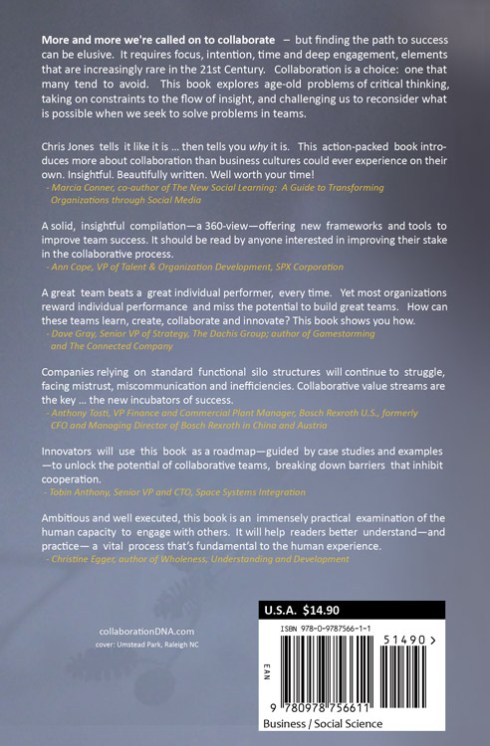
It’s Time for New Choices (from the back cover)

More and more we’re called upon to collaborate – but the factors that determine our success can be elusive. Collaboration requires focus, intention, time and engagement, key elements that are far too scarce in the 21st Century.

Collaboration is a choice. And it’s a choice many will avoid.

With application across commercial, social and public domains, this book introduces Collaboration DNA as the basic building blocks of team-based problem solving, the tools needed to attack our ever more difficult challenges:

  • Frameworks – simple, accessible ways to describe our abstract ideas
  • Messaging – improving our communication through language, metaphor  & story
  • Relationships – exploring listening, culture change, interpersonal dynamics and new, more flexible modes of governance
  • Flow – expanding scenarios for space, roles and process, with a look at virtual tools and how social technologies are changing the game
  • Possibilities – looking at the evolution of  knowledge management, a return to critical thinking and a new appreciation for complexity

The world isn’t waiting for us. The pressure is on. We must find ways to unlock the potential of our organizations, many of them gridlocked by the structural hierarchies left over from the century-old Industrial Revolution. Collaboration is not easy. But it promises deep rewards for those who invest time in getting it right.

The DNA of Collaboration is a practical guide for teams who intend to do better. And it’s not just a book, it’s conversation. Keep an eye on hashtag #cdna as we begin to unpack the core topics online.

Here’s a look at that back cover, including some testimonials:

cdna-COVER-v5g-SEP_back

The DNA of Collaboration (back cover)

Want to hear the latest?  Follow us on Twitter: @collabdna (book) and @sourcepov (author).